Customize GitHub runners for swack-tools and create the Cloudflare control plane
This guide explains how to create and deploy a pure-Rust Cloudflare Worker backed by Cloudflare Workers KV, and how to customize persistent GitHub Actions runners for swack-tools repositories by using declarative runner patch manifests and the native Rust host agent.
Part 1 for creating and deploying the Cloudflare control plane
The edge control plane runs as a serverless Cloudflare Worker compiled from Rust to wasm32-unknown-unknown. It stores all state inside a single consolidated Cloudflare Workers KV document, serves the management web interface in under 15 milliseconds, and runs a 5-minute scheduled cron reconciler without requiring always-on control virtual machines (VMs) or Cloudflare Tunnels.
flowchart LR
    Operator["Operator Browser or CLI"] -->|"HTTPS + OAuth 2.0"| Worker["Rust Cloudflare Worker (Wasm)"]
    Cron["5-Minute Cron Trigger"] -->|"#[event(scheduled)]"| Worker
    Worker -->|"60s In-Isolate Cache"| Cache["thread_local! STATE_CACHE"]
    Cache -->|"Single Consolidated Key"| KV["Cloudflare Workers KV (STATE_KV)"]
    Worker -->|"REST API + PR Creation"| GitHub["GitHub Actions (swack-tools)"]
    Worker -->|"Instances API"| Cloud["Cloud Compute Fleet"]
Step 1 for authenticating Wrangler and creating the KV namespace
Install the Cloudflare wrangler command-line tool and worker-build, then authenticate with your Cloudflare account:
In the Cloudflare dashboard, navigate to Compute > Workers & Pages to review your account overview and daily request quotas before creating the Worker:
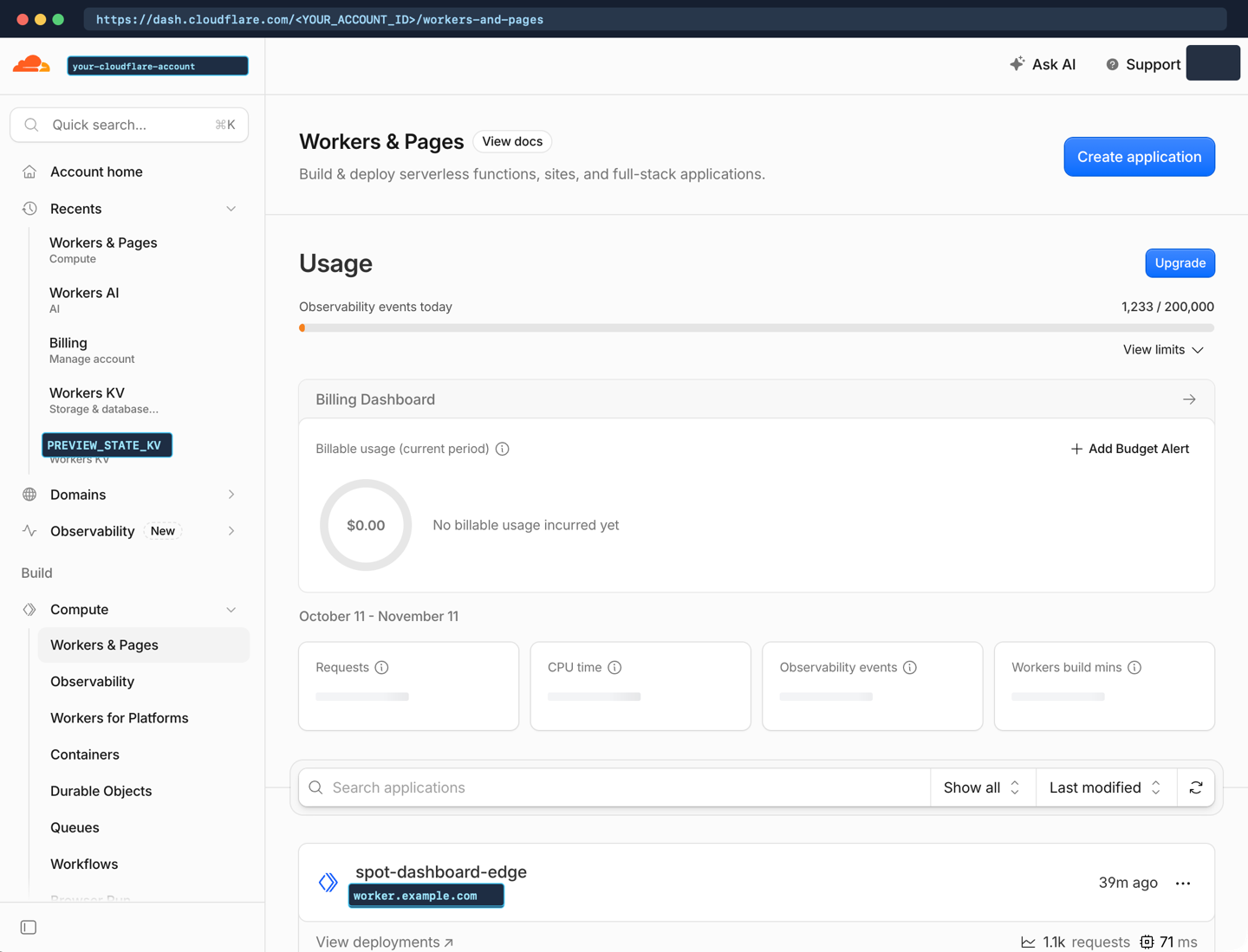
Create the production and preview Workers KV namespaces from the command line, or select Storage & databases > Workers KV > Create a KV namespace in the Cloudflare dashboard:
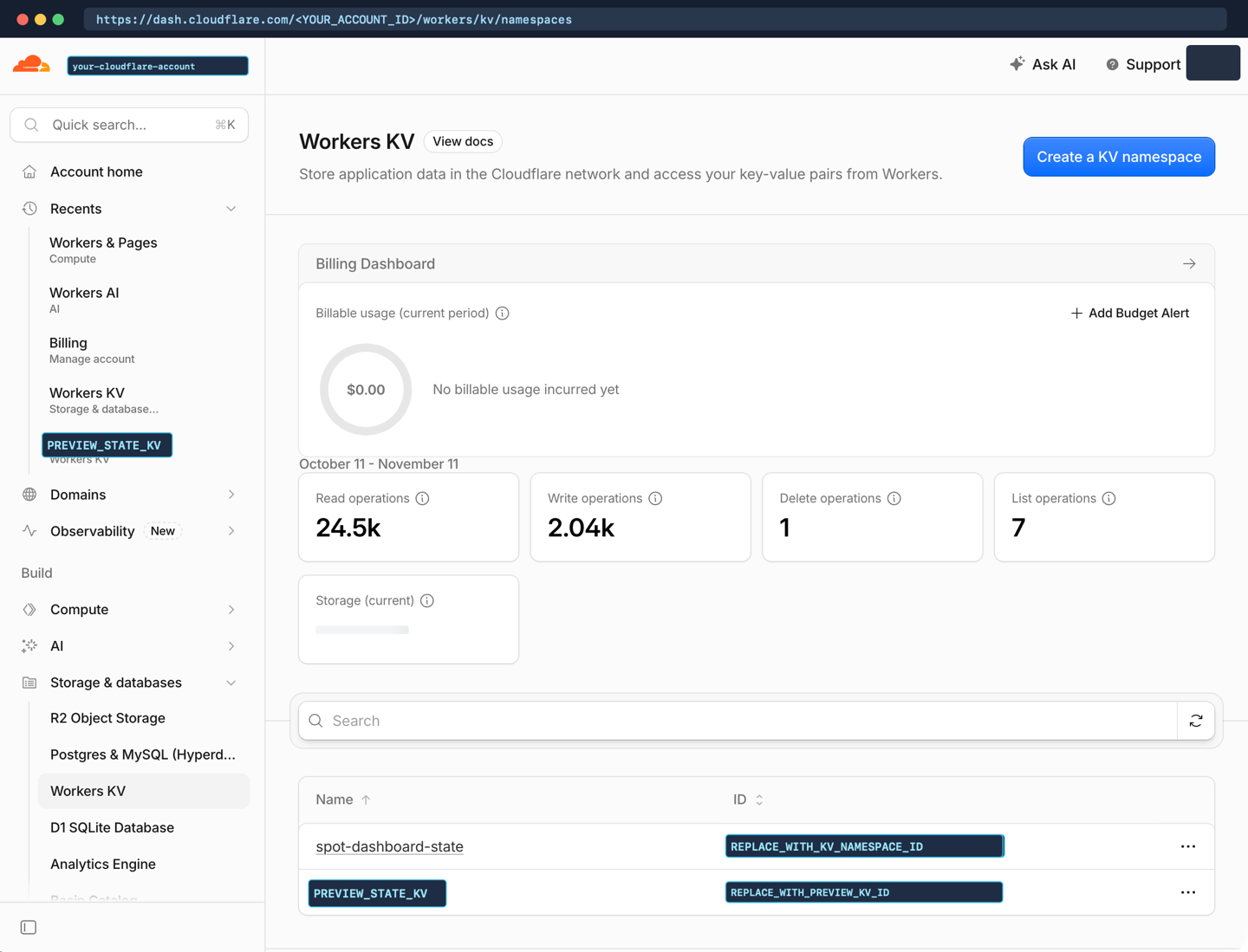
Copy the namespace identifier returned by Wrangler (or shown in the Workers KV table) and replace REPLACE_WITH_KV_NAMESPACE_ID in cloudflare/wrangler.toml:
name = "cf-worker-kv-template"
main = "build/worker/shim.mjs"
compatibility_date = "2026-06-01"
workers_dev = false
preview_urls = false

kv_namespaces = [
  { binding = "STATE_KV", id = "REPLACE_WITH_KV_NAMESPACE_ID" },
]

[build]
command = "worker-build --release"

[vars]
SESSION_NOT_BEFORE = ""
GITHUB_ORG = "swack-tools"
DEFAULT_TARGET_REPO = "swack-tools/oxidex"

[triggers]
crons = ["*/5 * * * *"]

[observability]
enabled = true
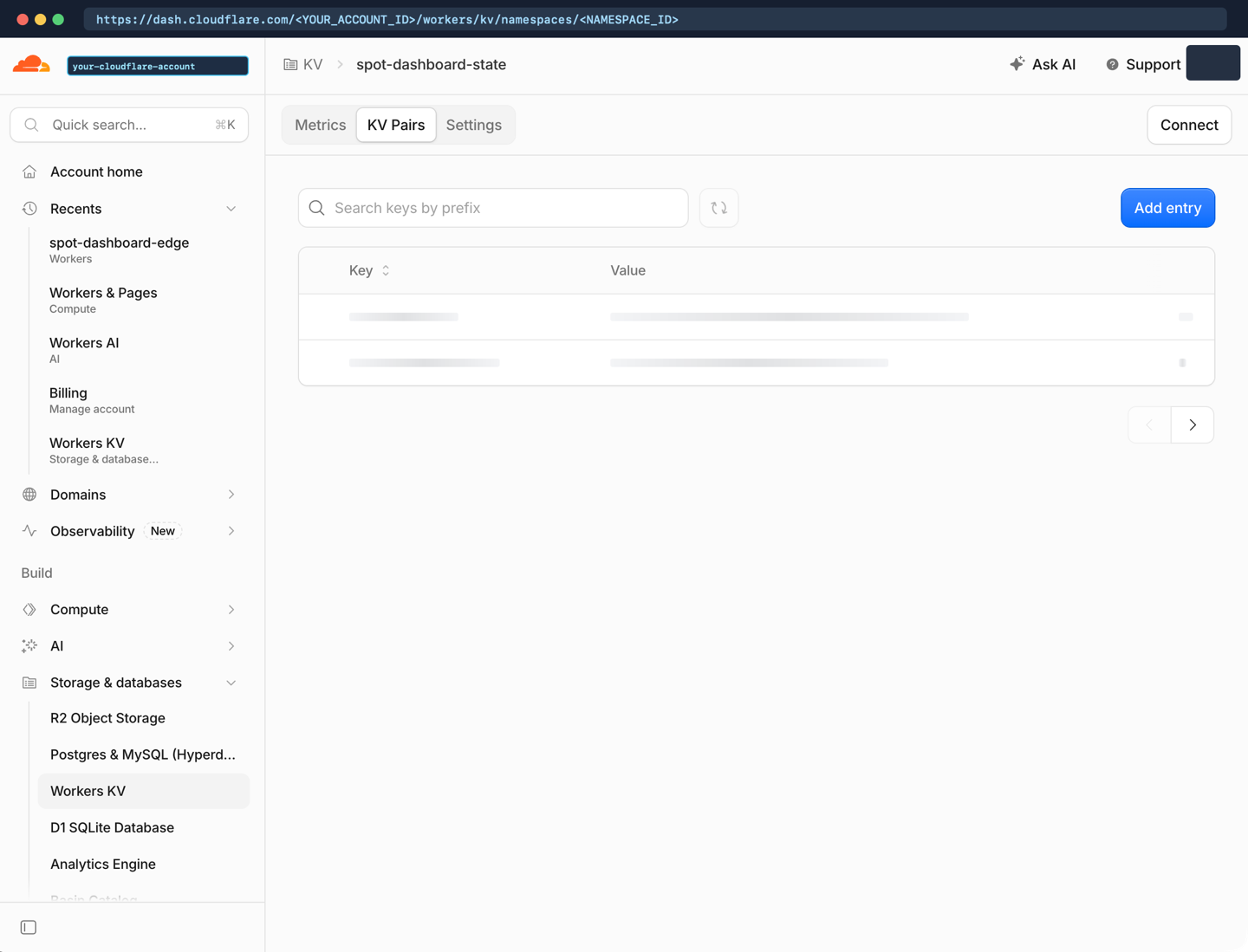
When you open the namespace under Storage & databases > Workers KV and select the KV Pairs tab, you can inspect the consolidated state entry (app:state) and lease key (app:lease) stored in that namespace:
Step 2 for provisioning Cloudflare worker secrets
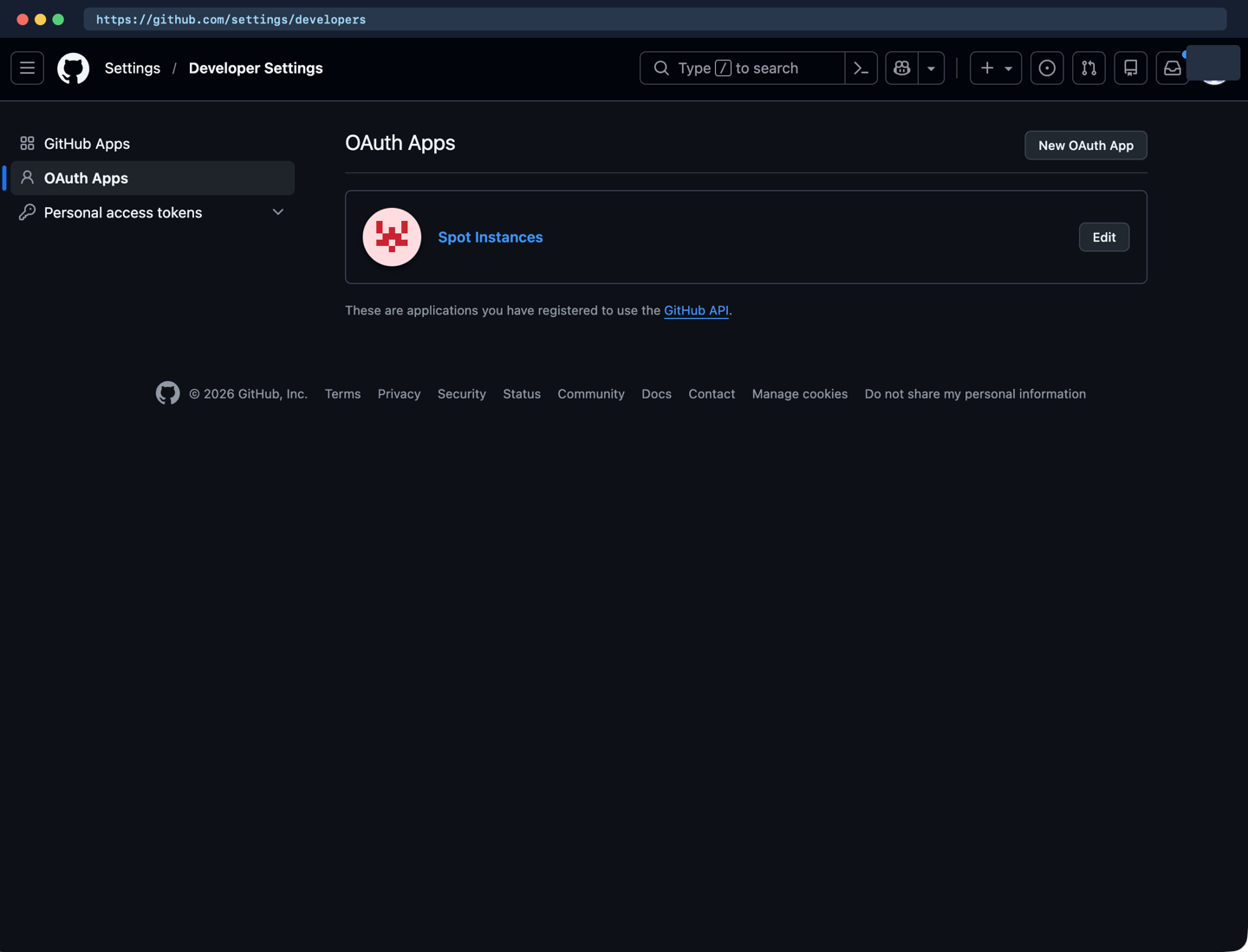
First, register an OAuth 2.0 app on GitHub under Settings > Developer Settings > OAuth Apps > New OAuth App (or under your organization settings) and set the callback URL to https://worker.example.com/auth/callback:
Never store secrets in wrangler.toml or commit them to Git. Provision each secret through wrangler secret put:
cd cloudflare

# 32-byte hex secret used to sign HMAC-SHA256 session cookies
openssl rand -hex 32 | wrangler secret put SESSION_SECRET

# GitHub OAuth 2.0 application credentials for operator sign-in
wrangler secret put GITHUB_OAUTH_CLIENT_ID
wrangler secret put GITHUB_OAUTH_CLIENT_SECRET

# Renewable GitHub token or App credentials for runner JIT registration
wrangler secret put GITHUB_RUNNER_TOKEN

# Cloud provider service account JSON key for fleet reconciliation
wrangler secret put GCP_SERVICE_ACCOUNT_KEY
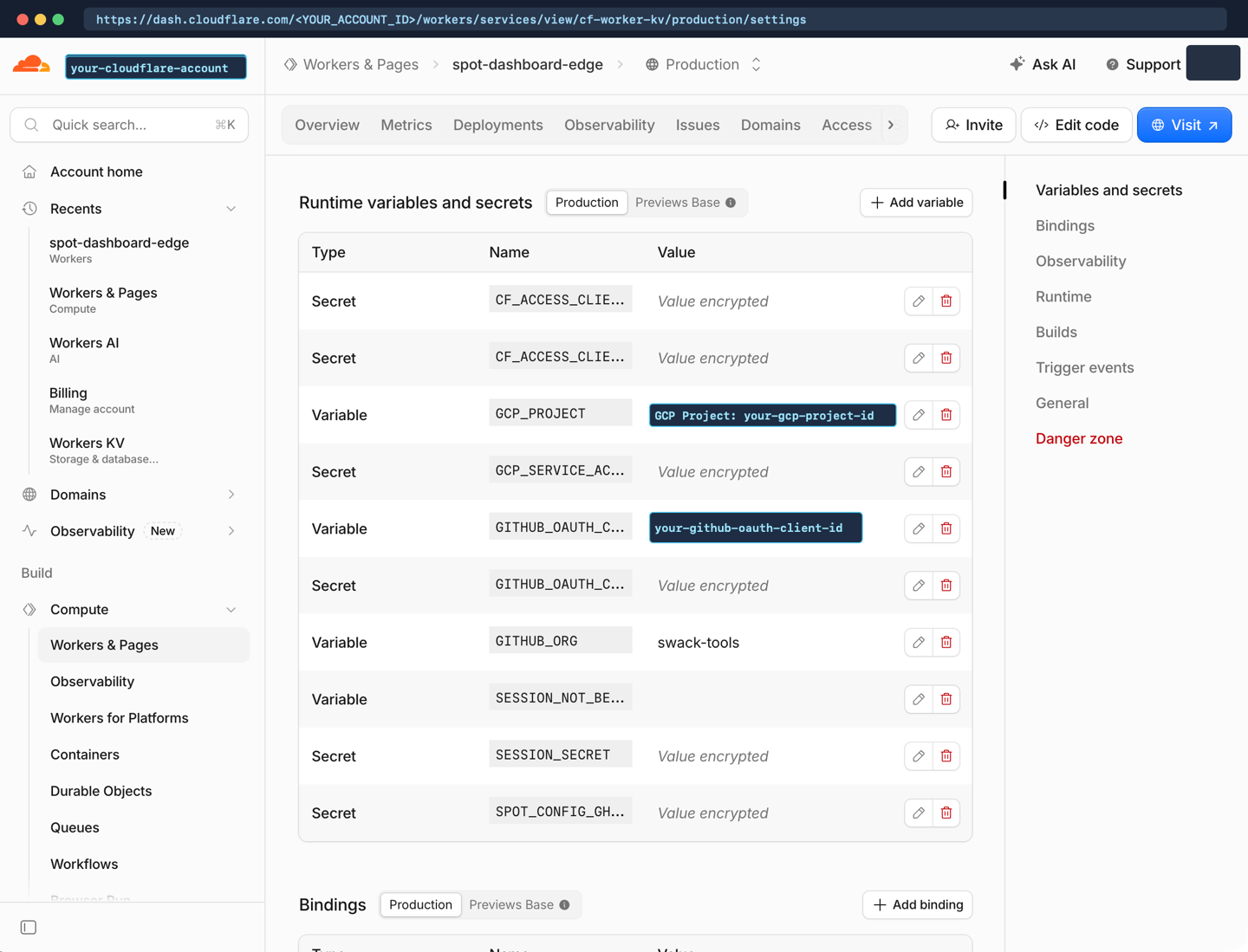
In the Cloudflare dashboard, open your Worker and navigate to Settings > Variables and secrets to confirm that sensitive values appear as Value encrypted alongside your plain-text runtime variables (GITHUB_ORG, SESSION_NOT_BEFORE) and STATE_KV binding:
Step 3 for verifying KV quota invariants before deploying
To operate reliably within Cloudflare Free Tier limits (100,000 KV reads per day and 1,000 KV writes per day), the Rust Worker enforces four storage rules in cloudflare/src/state.rs:
- Consolidated document key (
app:state): all configuration, runner profiles, administrator records, and fleet telemetry reside in a single JSON envelope (StateBundle). Loading or persisting state uses at most oneKVoperation. - In-isolate memory cache (
thread_local!): each Worker isolate caches the parsedStateBundlein memory for 60 seconds (STATE_CACHE_TTL_SECS). Read endpoints (/,/api/health,/api/state,/api/items) serve warm requests in under 0.1 milliseconds with zeroKVreads. SHA-256fingerprint diff-gating: before writing toKV,save_state_if_changedhashes the canonical JSON payload withSHA-256(state_fingerprint). If a 5-minute cron tick produces no state change, the Worker skipskv.put(...)completely (WriteOutcome::SkippedUnchanged).- Distributed lease locking (
app:lease): scheduled cron reconcilers acquire a short-livedKVlease viaacquire_leasebefore mutating state so overlapping ticks never overwrite concurrent operator updates.
Run the native Rust test suite and build the release Wasm bundle to verify these invariants locally:
Step 4 for deploying the worker and verifying edge endpoints
Deploy the compiled WebAssembly Worker to Cloudflare's edge network:
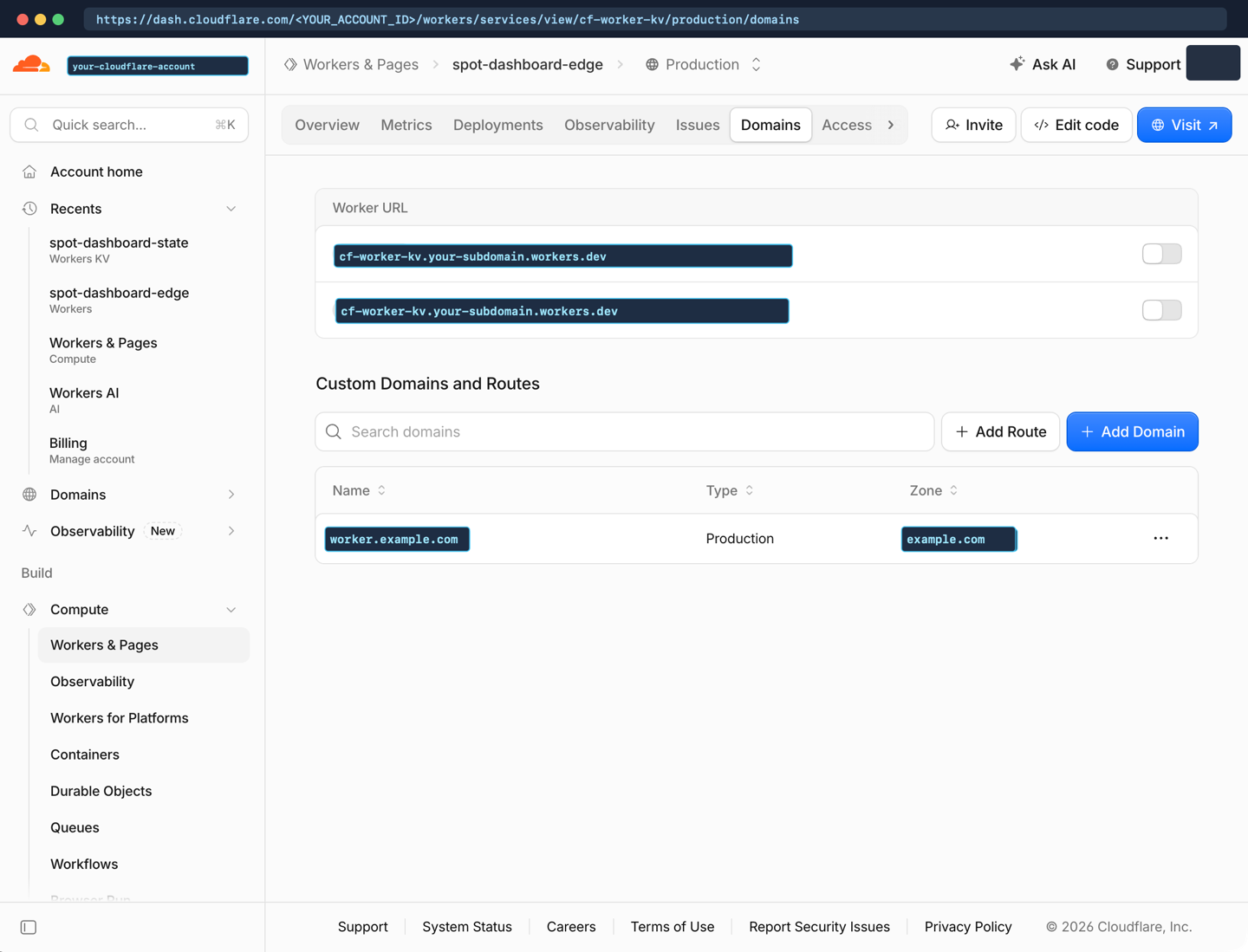
In the Cloudflare dashboard, open the Domains tab for your Worker to bind your production custom domain (such as worker.example.com) and verify that both the *.workers.dev route and preview URLs remain turned off (workers_dev = false and preview_urls = false):
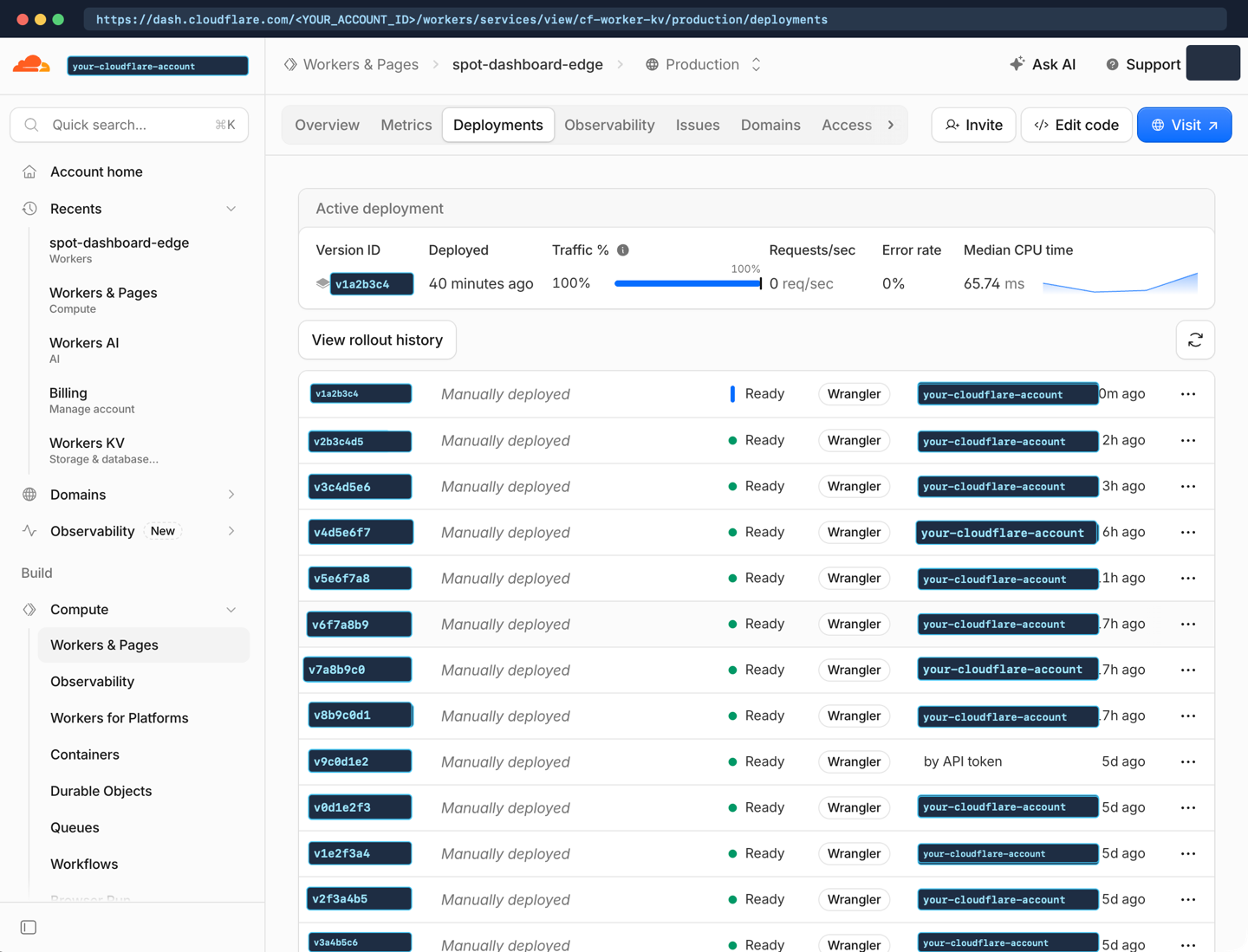
Open the Deployments tab to confirm that the latest Wrangler rollout serves 100% of production traffic and to inspect version rollout history:
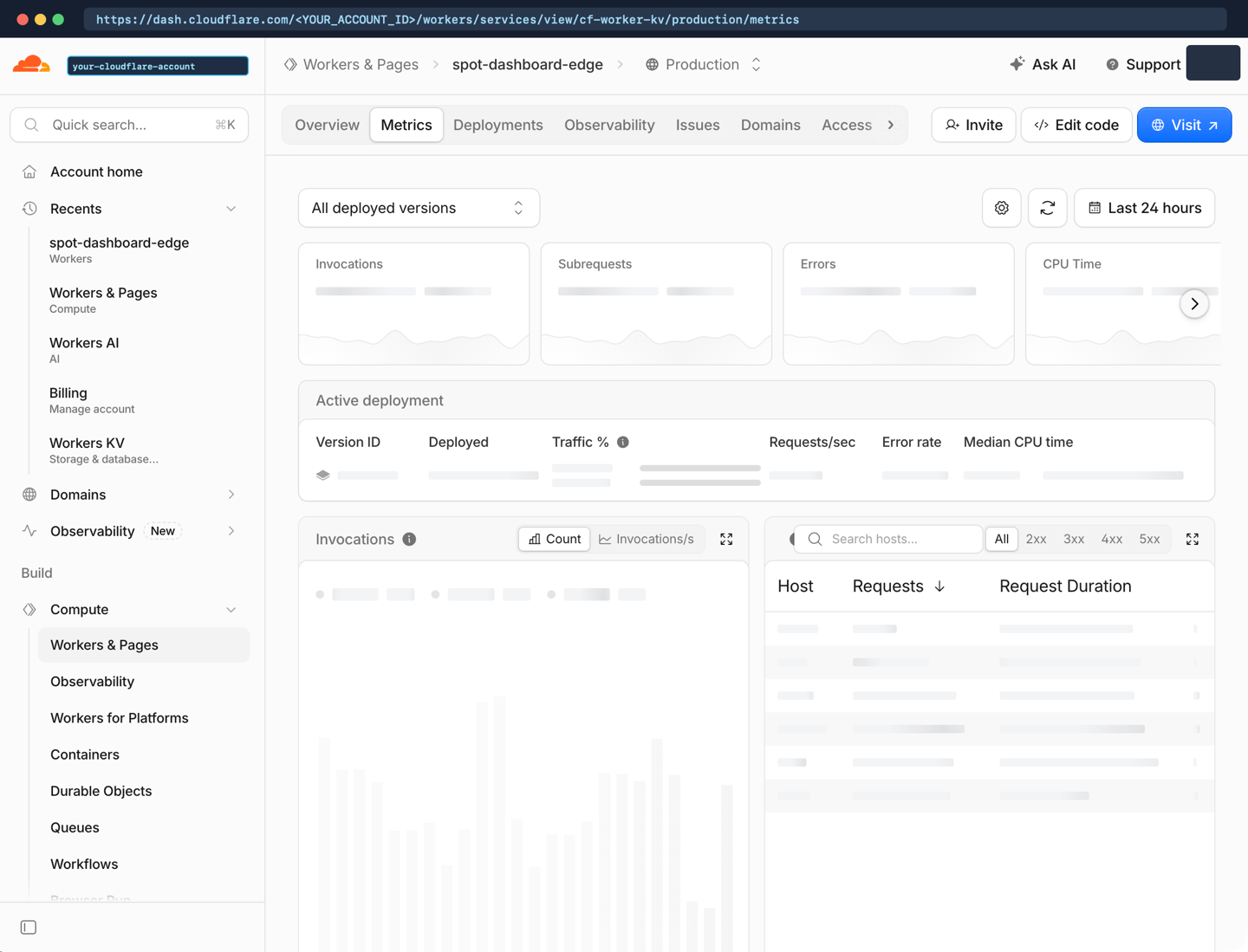
Select the Metrics tab to monitor live edge invocations, subrequests, error rates, and median CPU execution time:
Verify the deployment from the command line by querying the read-only health endpoint:
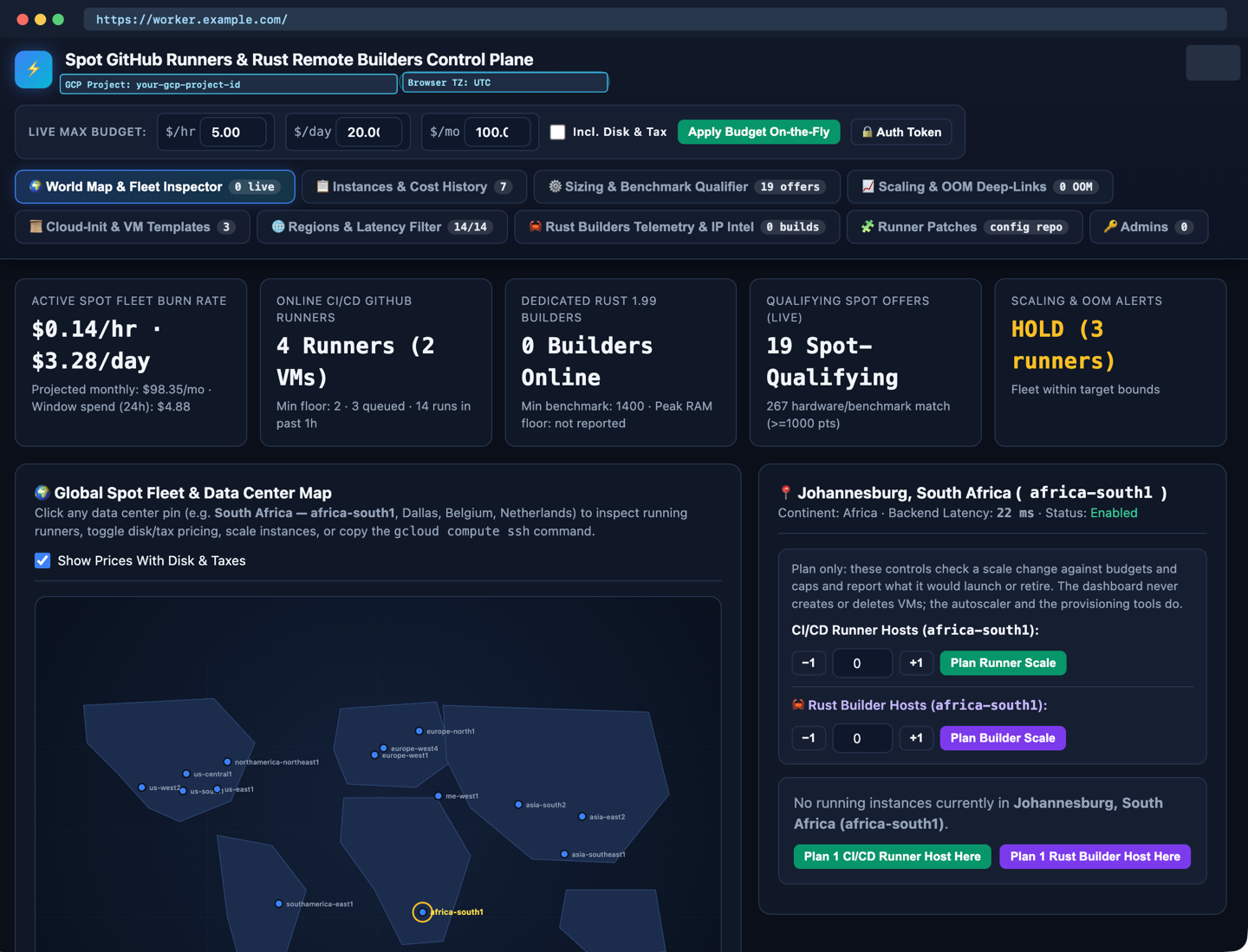
Finally, open https://worker.example.com/ in your browser to inspect the embedded pure-Rust edge web interface hydrated directly from the single consolidated STATE_KV state bundle:
Part 2 for customizing GitHub Actions runners for swack-tools
Repositories in the swack-tools organization customize their GitHub Actions runner hosts and runner containers declaratively through spot-runner-patch-v1 manifests rather than manual SSH edits.
Where swack-tools runner manifests live
Runner patch manifests live in a central configuration repository (swack-tools/spot-runners-config by default):
| Path | Scope | Purpose |
|---|---|---|
defaults.yaml |
Organization-wide (swack-tools) |
Base hardware sizing, kernel parameters, and packages inherited by every repository. |
repos/swack-tools/<repo>.yaml |
Single repository (for example, repos/swack-tools/oxidex.yaml) |
Repository-specific hardware, ISA, package, sysctl, file, and container mount overrides. |
When rendering a runner configuration for swack-tools/<repo>, the loader fetches defaults.yaml and repos/swack-tools/<repo>.yaml from the pinned commit on the default branch, merges them deterministically, validates the combined manifest, and computes the canonical SHA-256 patch digest.
Write a spot-runner-patch-v1 manifest for swack-tools
A runner patch manifest contains three primary sections: hardware, host, and container. Below is a complete example for repos/swack-tools/oxidex.yaml:
schema: spot-runner-patch-v1
repository: swack-tools/oxidex

hardware:
  arch: x86_64
  isa:
    - avx2
    - avx512
  extra_labels:
    - rust-1.99
    - avx512-verified
  min_vcpu: 16
  min_ram_gib: 32
  runners_count: 2
  runner_vcpu: 7
  runner_ram_gib: 14
  host_overhead_gib: 4
  queued_jobs_threshold: 20
  qualify_command: |
    rustc --version
    cargo --version

host:
  apt_packages:
    - jq
    - socat
    - zstd
  sysctl:
    vm.max_map_count: "262144"
    fs.inotify.max_user_watches: "524288"
  boot_mkdirs:
    - /mnt/runner-data/cargo-cache
  files:
    - path: /etc/runner-environment.conf
      content: |
        OXIDEX_CLEAN_TARGET=1
      mode: "0644"
      owner: root:root
  boot_script: |
    chmod 0755 /mnt/runner-data/cargo-cache

container:
  apt_packages:
    - clang
    - lld
    - pkg-config
    - libssl-dev
  sysctl:
    net.ipv4.ip_local_port_range: "10240 65535"
  mounts:
    - source: /mnt/runner-data/cargo-cache
      target: /work/.cargo
      read_only: false
  dockerfile_run: |
    rustup component add clippy rustfmt
Understand hardware sizing and CPU instruction set filtering
The hardware section governs how the Cloudflare Worker reconciler selects cloud machine families and sizes runner containers:
- Memory and
CPUallocation: on a 16-vCPU, 32 GiB RAM host, reservinghost_overhead_gib: 4leaves 28 GiB for two runner containers (runners_count: 2), each capped atrunner_vcpu: 7andrunner_ram_gib: 14. - Instruction set architecture (
isa) filtering: declaringavx2,avx512,avx512-vbmi2,amx, oravx10.1onx86_64(orneon,sve, andsve2onarm64) restricts provisioning to cloud machine families whoseCPUplatforms expose the corresponding/proc/cpuinfoflags. - Backlog scaling (
queued_jobs_threshold): when queued workflow jobs forswack-toolsreach or exceed the configured threshold (for example,20), the 5-minute Worker reconciler provisions additional Spot runner hosts and mints 2-slot Just-in-Time (JIT) runner configurations through the GitHub Actions API.
Merge rules between defaults.yaml and repository overrides
When the Worker merges defaults.yaml with repos/swack-tools/<repo>.yaml, it applies deterministic per-field rules:
| Field group | Merge behavior |
|---|---|
Scalar hardware settings (arch, min_vcpu, min_ram_gib, runners_count, runner_vcpu, runner_ram_gib, host_overhead_gib, queued_jobs_threshold) |
Repository value overrides the default when present. |
Lists (isa, extra_labels, apt_packages, boot_mkdirs) |
Union with default entries first and duplicates removed. |
Key-value mappings (sysctl) |
Merged by key; the repository value wins on conflicts. |
File lists (host.files, container.files) and container.mounts |
Merged by path (for files) or target (for mounts), replacing matching default entries. |
Scripts (boot_script, dockerfile_run) |
Concatenated with a newline, default script first. |
Enforce host and container security boundaries
Customizations applied to swack-tools runners must preserve four runtime security invariants enforced by the validator and the native pure-Rust host-agent binary:
- Forbidden container mounts:
container.mountsstrictly rejects/var/run/docker.sock,/run/docker.sock,/run/gha-admission,/var/lib/gha-admission,/etc,/root,/proc,/sys,/dev, and any parent or child path of those directories. - Memory lease admission (
host-agent host-admission): registered GitHub listener counts do not equal concurrent memory capacity. Before a workflow job runs,runner/job-started.shacquires a memory lease over/run/gha-admission/socketbacked by/var/lib/gha-admission/leases.json, blocking if active jobs would exceed host headroom. - Descriptor-safe workspace cleanup (
host-agent clean-target): when a job finishes,runner/job-completed.shinvokeshost-agent clean-targetto remove the workspacetarget/directory using descriptor-relativeunlinkatwithAT_SYMLINK_NOFOLLOW, preventing symlink traversal outside the workspace. - Loopback port wrapping (
host-agent docker-wrapper): intercepts container launch commands to bind published ports to127.0.0.1and manage localsocatrelays.
Apply runner patches through the patch console
Instead of editing runner hosts by hand, apply changes through the Cloudflare Worker dashboard:
- Open the Worker dashboard, sign in with GitHub OAuth 2.0, and select the Runner Patch Console tab.
- Choose
swack-tools/<repo>(ordefaults.yaml) to load the current manifest and its merged canonicalSHA-256digest. - Edit the YAML manifest and run validation. The pure-Rust validator rejects unknown keys, invalid package names, and forbidden mount paths immediately.
- Save the patch to open a branch and pull request against
swack-tools/spot-runners-config. - Once the pull request merges to
main, the Cloudflare Worker reconciler detects the updated canonicalSHA-256digest on its next cron tick and rolls out the customization across the runner fleet.